




What is Galden®?
Galden® PFPE is a family of inert, high-performance, fluorinated fluids that offer good dielectric properties, exceptional chemical stability, and the capacity to operate at very low as well as elevated temperatures in aggressive conditions, making them useful in many industrial applications. Typical operating temperatures range from -70°C to 290 °C (-94°F to 554°F).
Thermal Properties (Galden® HT)
Galden® HT heat transfer fluids have boiling points ranging from 55°C to 270°C (131°F to 518°F), which is broader than other commercial fluorinated heat transfer fluids. Boiling points of High Boiler (HB) grades range from 170°C to 270°C (338°F to 518°F), which enables Galden® PFPE to be used at end-use temperatures up to 290°C.
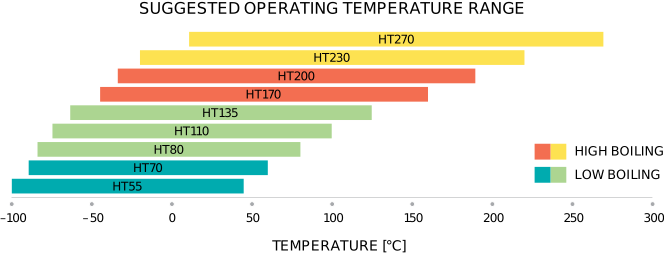
Suggested operating temperature ranges are summarized below. The lower limit is set when the fluid viscosity reaches 20 cP (11-12 cSt), which is the typical operating range of many commercially available fluid pumps. The upper limit is set at 10°C (18°F) below the boiling point of the fluid itself.
Viscosity and Pour Point
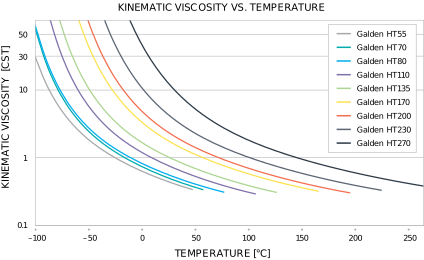
Viscosity is a measure of a fluid's resistance to flow. It is generally temperature-dependent, decreasing as temperature increases and increasing as the temperature decreases.
Pour point is the lowest temperature at which a fluid will flow. This property is crucial for fluids that must flow at low temperatures. A commonly used rule of thumb when selecting fluids is to ensure that the pour point is at least 10 °C lower than the lowest anticipated ambient temperature. Galden® HT fluids offer a wide variety of very low-temperature pour points, ranging from -66°C to -115°C (-76°F to -175°F).
Electrical Properties
Galden® PFPE's excellent dielectric properties are the primary reason they are used in many applications. Dielectric strength is 40 kV at 2.54-mm gap. Volume resistivity is 1.5 1015Ohm cm.
Flame Properties
Galden® PFPE fluids are not flammable and have no flash, fire or auto-ignition point. They are approved by Factory Mutual Underwriters and compliant with FM Standard 6930 for fluid safety.
Compatibility with Materials
Commonly encountered materials of construction can be classified into metals, plastics and elastomers. The compatibility of these materials with Galden® PFPE fluids depends on the base material and the formulations used in making the seals, gaskets and hoses as well as the operating temperatures and temperature cycling.
The compatibility of pure materials can be different from formulated materials. Hence, compatibility testing should be performed with the actual seals, gaskets and other components under operating conditions.
General guidelines for the compatibility of Galden® PFPE Fluids based on immersion testing are summarized in the following table.
| Metals | AISI 316, Copper, Brass, Iron, Nickel, Aluminum, Stainless Steel, Bronze |
|---|---|
| Plastics | LDPE, PP, PC, ABS copolymers, PET, POM, PTFE, PVC, PMMA, Polyphenyloxide |
| Elastomers | Butyl Rubber, Natural Rubber, Silicone Rubber, NBR, EPDM, Fluorosilicone |
NSF Approvals for Food Contact
Select Galden® PFPE fluids are NSF approved based on related intended uses.
| H1 | General, incidental contact |
|---|---|
| HT1 | Heat transfer fluids, incidental contact |
| HTX1 | Ingredients for use in HT1 heat transfer fluids |
| HX1 | Ingredients HX1 for use in H1 lubricants, incidental contact |
3M Replacement
In a significant shift, 3M announced its decision to exit the fluoropolymer market by the end of 2025. This move is part of a broader strategy to discontinue the manufacturing of per- and polyfluoroalkyl substances (PFAS), commonly known as "forever chemicals," due to their environmental and health impacts. This decision includes discontinuing their entire line of Novec™ and Fluorinert™ fluids.
Syensqo's Galden® PFPE fluids emerge as an ideal replacement for 3M's fluoropolymer products. These high-performance, fluorinated fluids are available for immediate use.
Syensqo's Galden® PFPE fluids offer exceptional chemical stability, good dielectric properties, and the ability to operate across a wide temperature range, from -70°C to 290°C. Their inert nature and versatility make them suitable for various industrial applications, including electronics, aerospace, and automotive sectors. With their robust performance in aggressive conditions, Galden® PFPE fluids ensure reliability and efficiency, positioning Syensqo as a leader in providing sustainable and effective solutions.
The available chart shows 3M Fluids and the recommended Galden® replacement. Choosing the right fluid can mitigate the risks of equipment damage, unscheduled downtime, and operational inefficiencies.
| 3M Recommended Fluid | Application | Recommended Galden® Replacement |
|---|---|---|
| FC87, FC72 | Heat Transfer Fluid, 55°C | HT55 |
| FC84, HFE7100, HFE7200 | Heat Transfer Fluid, 70°C | HT70 |
| FC77 | Heat Transfer Fluid, 110°C | HT110 |
| FC3283, HFE7500 | Heat Transfer Fluid, 135°C | HT135 |
| FC40, FC43 | Heat Transfer Fluid, 170°C | HT170 |
| FC70 | Heat Transfer Fluid, 200°C | HT200 |
Specifications Table (Typical Value)
| Grade | |||||||||
|---|---|---|---|---|---|---|---|---|---|
| Vapor Pressure | |||||||||
| Pour Point | |||||||||
| Boiling Point | |||||||||
| Specific Heat (Cal/g•°C) | |||||||||
| Surface Tension | |||||||||
| Molecular Weight | |||||||||
| Heat of Vaporization | |||||||||
| Kinematic Viscosity | |||||||||
| Thermal Conductivity | |||||||||
| Relative Density | |||||||||
| Volume Resistivity | |||||||||
| Solubility of Water (ppm by wt) | |||||||||
| Dielectric Strength | |||||||||
| Dielectric Constant | |||||||||
| Solubility of Air (cm3 gas/100 cm3 liquid) | |||||||||
| Operating Range |
SDS Files
 HT55-5KG SDS
Technical Data Sheets
 HT80-5KG Datasheet
Semicon Heat Transfer Fluid
Application Details
A drifting of the wafer temperature can severely affect the process final results in Plasma Dry Etching, PECVD, PVD, etc. Furthermore, these systems run 24-7 and each moment of downtime can lead to extremely high costs for the fabs.
Applicable Galden® grades:
All of the grades, depending on the applications temperature range.
Customer Needs
- Good thermal resistance
- High breakdown voltage
- High volumetric electrical resistance
- High purity to avoid contamination risks in case of spills
- Long term stability of critical properties
- Low evaporation losses
- No ignition risk
Why Galden® vs Competitors
- No flashpoint (FM 6930 approved)
- Wide temperature range (-100°C to 290°C)
- Good heat transfer
- Low viscosity at very low temperatures
Server Blade Immersion Cooling (Single Phase)
Application Details
Immersion of server blades or other high power density computing boards in a heat transfer fluid to achieve efficient and reliable heat removal. Can drastically reduce temperature spikes and prolong components life.
Applicable Galden® grades:
HT55, HT70 (depending on devices)
Customer needs
- Boling point that is lower than the max acceptable temperature for the electronic components
- Good material compatibility to avoid specialized materials (standard components)
- Low dielectric dissipation at high frequencies
- Low dielectric constant
- High electrical volume resistance
- No fluid degradation
Why Galden® vs Competitors
- Best compatibility
- Best dielectric properties
- Non-reactive
- Non-flammable even if it has such low boiling point
Server Blade Immersion Cooling (Two - Phase)
Application Details
Immersion of server blades or other high power density computing boards in a heat transfer fluid to achieve efficient and reliable heat removal. Can drastically reduce temperature spikes and prolong components life. Theoretically two-phase can be significantly more power dense than single-phase heat transfer BUT is more complex to implement.
Applicable Galden® grades:
HT55, HT70 (depending on devices)
Customer needs
- Boling point that is lower than the max acceptable temperature for the electronic components
- Good material compatibility to avoid specialized materials (standard components)
- Low dielectric dissipation at high frequencies
- Low dielectric constant
- High electrical volume resistance
- No fluid degradation
Why Galden® vs Competitors
- Best compatibility
- Best dielectric properties
- Non-reactive
- Non-flammable even if it has such low boiling point
Power Electronics &/or Battery Cooling (Single-phase)
Application Details
Immersion cooling of power electronics can dramatically simplify the cooling system eliminating point of failures (e.g. loss of thermal contact between components). The high voltage and powers involved can pose significant incendiary risk, as does Lithium batteries run off.
Applicable Galden® grades:
HT135, HT170, HT200
Customer needs
- Low dielectric constant
- High electrical volume resistance
- High breakdown voltage
- Low dielectric constant
- Good material compatibility to avoid specialized materials (standard components)
- No fluid degradation
- No fueling of thermal run offs
Why Galden® vs Competitors
- Best compatibility
- Best dielectric properties
- Non-reactive
- Non-flammable
- Non-toxic
Aerospace HTF
Application Details
Thermal control systems in aerospace applications have very stringent requirements in terms or reliability and system robustness. Critical systems may make use of heat transfer fluids in radiation-heavy environments (space) and not be substituted for many years. Furthermore temperatures swings may be extreme.
Applicable Galden® grades:
HT80, HT110, HT135, HT170
Customer needs
- Boiling point that is lower than the max acceptable temperature for the electronic components
- Good material compatibility to avoid specialized materials (standard components)
- Low dielectric dissipation at high frequencies
- Low dielectric constant
- High electrical volume resistance
- No fluid degradation
Why Galden® vs Competitors
- Non-reactive
- Non-flammable
- Non-toxic
- Low viscosity at lower temperatures
Freeze Drier HTF
Application Details
Freeze drying is used in pharma and food industry to rapidly remove water from products without exposing them to higher temperatures and thus risking damaging them. These systems require fluid to quickly bring away heat from the drying racks. In some cases a non-flammable option can be preferred to lower insurance policies or work in specific contexts.
Applicable Galden® grades:
HT80, HT110, HT135, HT170
Customer needs
- Clean and inert
- Resist sterilization cycles above 100°C without degradation
- Capability of cooling down to -50°C (even -80 °C in specific cases)
- Good thermal conductivity
Why Galden® vs Competitors
- Cleaner than silicone oil
- Non flammable
- Wide temperature range (-100°C to 290°C)
- Good heat transfer
- Low viscosity at very low temperatures
Frequently Asked Questions
Galden® HT heat transfer fluids have boiling points ranging from 55°C to 270°C (131°F to 518°F), which is broader than other commercial fluorinated heat transfer fluids. Boiling points of High Boiler (HB) grades range from 170°C to 270°C (338°F to 518°F), which enables Galden® PFPE to be used at end-use temperatures up to 290°C (554°F).
Suggested operating temperature ranges are summarized below. The lower limit is set when the fluid viscosity reaches 20 cP (11-12 cSt), which is the typical operating range of many commercially available fluid pumps. The upper limit is set at 10°C (18°F) below the boiling point of the fluid itself.
Pour point is the lowest temperature at which a fluid will flow. Galden® HT fluids offer a wide variety of very low temperature pour points, ranging from -66°C to -115°C (-76°F to -175°F). A rule of thumb when selecting fluids is to ensure that the pour point is at least 10°C (18°F) lower than the lowest anticipated ambient temperature.
Viscosity is a measure of a fluid's resistance to flow, which generally decreases as the temperature increases and increases as the temperature decreases. For many heat transfer applications, the lower temperature limit (pumpability limit) is set when the fluid viscosity reaches the value of 20 cP (11 - 12 cst).
Galden® PFPE fluids are not flammable as they have no flash, fire or auto-ignition points. These non-hazardous materials are Factory Mutual Underwriters approved and compliant with FM Standard 6930 for fluid safety.
Galden® PFPE fluids are stable in thermal conditions above 300 °C. In the presence of oxygen, however, the operating temperature is lowered to 290°C (554°F). Up to these temperatures, decomposition of the fluids is negligible.
Galden® PFPE fluids do not corrode metals because they interrupt the electrical circuit that is the basis for the corrosion process. The conducting environment for ionic movement is disabled by the high volume resistivity of Galden® PFPE, which does not vary in use. The volume resistivity of DI water is at least 107 ohm cm, a value that tends to reduce over time as DI water extracts metal ions.
Corrosion in Galden® PFPE heat transfer systems can generally be linked to either a separate water phase or thermal decomposition of the fluid. In order to have a separate water phase, the amount of water in the system must exceed the fluid's saturation level. The saturation level of water in Galden® PFPE fluids is usually < 20 ppm by weight. Water present in the fluid at or below this level has never been linked to corrosion. Water present above this level means a separate water phase. If such entrained water comes into contact with metal parts, corrosion can occur rapidly.
A fluoride ion can be generated any time the fluid is heated above its decomposition temperature, leading to corrosion. Thermal degradation for Galden® PFPE starts between 290°C to 300°C (554°F to 572°F). HF can be generated only when the fluid is brought above its decomposition temperature, which far exceeds typical operating working temperatures. Corrosion resulting from decomposition is very rare and only observed in systems that have undergone a failure. Examples include: a burned out heater, high voltage discharge in dielectric systems or a burned out electrical component in a direct contact electrical application.
Galden® PFPE fluids have excellent electrical properties, which is a key requirement for many applications. Dielectric strength is 40 kV at 2.54-mm gap. Volume resistivity is 1.5 x 10¹⁵ohm cm.
The saturation level of water in a Galden® PFPE fluid is usually < 20 ppm by weight.
General guidelines for the compatibility of Galden® PFPE fluids are summarized below.
| Metals | AISI 316, Copper, Brass, Iron, Nickel, Aluminum, Stainless Steel, Bronze |
|---|---|
| Plastics | LDPE, PP, PC, ABS copolymers,PET, POM, PTFE, PVC, PMMA, Polyphenyloxide |
| Elastomers | Butyl Rubber, Natural Rubber, Silicone Rubber, NBR, EPDM, Fluorosilicone |
You can select a heat transfer fluid based on two main parameters. The first is viscosity at the lowest operating temperature. This is typically < 20 cp ( 11-12 cSt) for fluorinated fluids for pumpability. The second is vapor pressure at the highest operating temperature. The boiling point of the fluid should be at least 10°C (18°F) higher than the highest operating temperature in order to avoid excessive pressure in the HT circuit, decrease fluid loss and reduce cavitation.
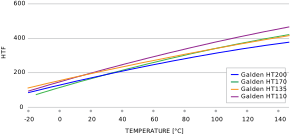
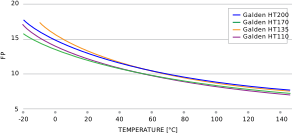
Heat transfer performance can be predicted by using the Heat Transfer Factor (HTf) and Pressure Drop Factor (Fρ). Both factors are functions of fluid properties and are subjected to change with temperature. A plot of HTf and Fρ vs. temperature can be used to compare fluids with the same TCU geometry and flow conditions.
Heat Transfer Factor (HTf):HTf = 0.023 x k 0.67 x (r cp) 0.33 x n - 0.47
Where:
k= Thermal conductivity
r= Density
cp= Specific heat
n= Kinematic viscosity
HTf compares the fluid's capacity to add or remove heat under fully developed turbulent flow conditions (Re > 10,000) for a given geometry. The higher the HTf, the better the heat transfer efficiency.
Pressure Drop Factor (Fρ):Fρ = 0.092 x ρ x ν 0.2
Where:
ρ= Density
ν= Kinematic viscosity
For Galden® PFPE fluids, we recommend using a heater watt density ≤ 4 ÷ 5 W/cm2in order to avoid instability in the heater surface temperature for low flow units (i.e. fluid reservoir in the TCU). Higher watt density heaters can be used if the heater section is located where the fluid flow is near the pump outlet. We recommend 4 W/cm2(critical breakdown occurs around 14 W/cm2). The decision to go beyond this level should be made by the customer.
Galden® LS/HS fluids are specifically designed for the Vapor Phase Soldering (VPS) process used to mount chips to printed circuit boards. A narrow molecular weight distribution and precise vapor temperature control are critical to this application. These properties are monitored by measuring distillation range (ASTM D1078) and boiling temperature (TRV ASTM D1120). Both properties are always included in material specifications.
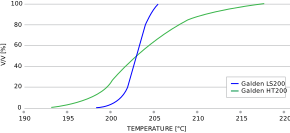
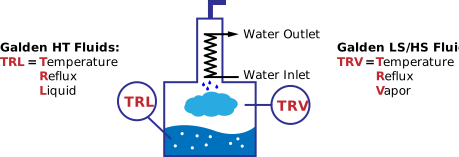
Boiling point is the temperature at which the vapor pressure of the liquid equals the environmental pressure surrounding the liquid (ASTM D1120).Temperature Reflux Liquid (TRL) relates to Galden® HT fluids, whereas Temperature Reflux Vapor (TRV) relates to Galden® LS/HS fluids.
Select Galden® PFPE grades are NSF approved based on related intended uses:
| H1 | General, incidental contact |
|---|---|
| HT1 | Heat transfer fluids, incidental contact |
| HTX1 | Ingredients for use in HT1 heat transfer fluids |
| HX1 | Ingredients HX1 for use in H1 lubricants, incidental contact |
Yes, Galden® PFPE fluids satisfy MIL requirements. Thermal shock testing is performed according to MIL STD 883 method 1011 or MIL STD 202 method 107. Hermetic seal testing is performed according to MIL STD 883, method 1014K; MIL STD 750, method 1071; and MIL STD 202, method 112.
MIL Property Standards for Testing Fluids
| Property | Value |
|---|---|
| Appearance | Clear, colorless |
| Density, 25 °C | 1.6 gm/cm3 |
| Dielectric strength, 2.54-mm gap | > 30 kV |
| Viscosity profile | According to the equipment manufacturer |
| Residue | < 50 ppm |
| Composition | No chlorine, no hydrogen* |
*This is not a standard and the use of products having chlorine or hydrogen is allowed.
When stored in their original sealed containers, Galden® PFPE fluids are chemically stable for over 20 years.
The density of Galden® PFPE fluids ranges from 1.66 to 1.86 g/cm3 at 20°C (68°F).
Ordering Table
All dimensions listed below, unless otherwise stated, are in grams.
| More Info |
Description | Grade | Weight | Safety Data Sheet | Part Number | Price | Ready to Ship | Add To Cart |
|---|---|---|---|---|---|---|---|---|
| More Info |
Description | Grade | Weight | Safety Data Sheet | Part Number | Price | Ready to Ship | Add To Cart |
|
GALDEN, |
HT55 | 5 KG |  |
HT55-5KG | P.O.R. |

|
||
|
GALDEN, |
HT70 | 5 KG | |
HT70-5KG | P.O.R. |
|
||
|
GALDEN, |
HT80 | 5 KG | |
HT80-5KG | P.O.R. |
|
||
|
GALDEN, |
HT110 | 5 KG | |
HT110-5KG | P.O.R. |
|
||
|
GALDEN, |
HT135 | 5 KG | |
HT135-5KG | P.O.R. |
|
||
|
GALDEN, |
HT170 | 5 KG | |
HT170-5KG | P.O.R. |
|
||
|
GALDEN, |
HT200 | 5 KG | |
HT200-5KG | P.O.R. |
|
||
|
GALDEN, |
HT230 | 5 KG | |
HT230-5KG | P.O.R. |
|
||
|
GALDEN, |
HT270 | 5 KG | |
HT270-5KG | P.O.R. |
|