




About the Authors
Nick Franzer – Process Engineer at the Kurt J. Lesker Company (Jefferson Hills, PA), specializing in thin film deposition and process control technologies.
Matthew R. Linford, Ph.D. – Professor in the Department of Chemistry and Biochemistry at Brigham Young University, with over 500 publications and more than 11,000 citations in surface science and materials chemistry.
J.R. Gaines, Jr. – Technical Director of Education at the Kurt J. Lesker Company, where he leads initiatives to advance knowledge in vacuum science and thin film deposition.
Excerpt from the article...
Plasma processes, especially reactive magnetron sputtering, have become foundational in the production of advanced thin film coatings across industries ranging from microelectronics to optics and energy. Yet, the inherent complexity and dynamism of plasma environments present significant challenges for process stability, film quality, film reproducibility, and throughput. Plasma Emission Monitoring (PEM) has emerged as a transformative analytical and control technique, enabling precise regulation of plasma chemistry during deposition. This article explores the principles, challenges, and industrial impact of this real-time, in situ characterization method for reactive magnetron sputtering.
1. Fundamentals of Reactive Magnetron Sputtering
In reactive magnetron sputtering (see Figure 1), a metal or ceramic target is bombarded with energetic ions, typically from an inert gas like argon, while a reactive gas (such as oxygen or nitrogen) is simultaneously introduced into the process chamber. This process enables the formation of compound thin films, e.g., TiN, TiO2, or Al2O3, by facilitating chemical reactions in the plasma phase and/or at the substrate surface. This approach combines the high deposition rates of metallic sputtering with the ability to form functional ceramics, oxides, or nitrides. These compound films are essential for applications in electronics, optics, and protective coatings.1
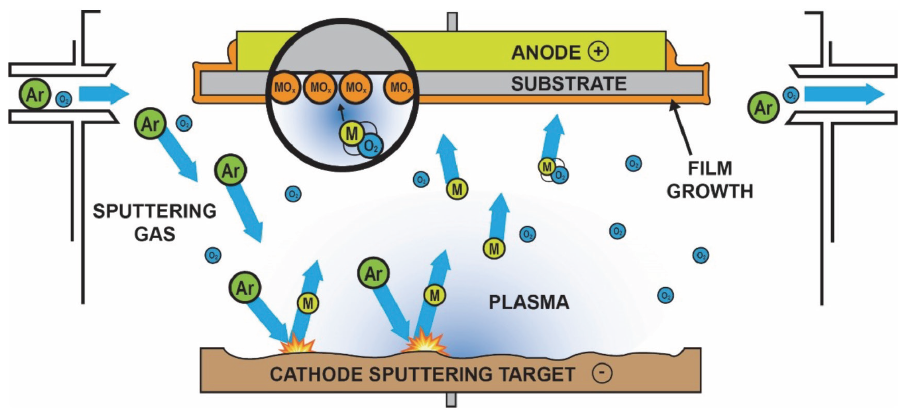
Reactive magnetron sputtering has three key process modes with regards to the target. They are 'metallic' or 'metal' mode, 'reactive' or 'fully poisoned' mode, and 'transition' mode. In the metallic or metal mode, the target surface remains mostly metallic, yielding high sputter rates. In the reactive or fully poisoned mode the target becomes coated with a compound, e.g., an oxide or nitride, drastically reducing its sputter rate. The 'transition' mode is an intermediate regime where both metallic and compound phases coexist. This mode often delivers an optimal balance of sputter rate and film composition.1
To read the rest of the article, please click here